
The Course of Empire Destruction — Thomas Cole
***
Today is one of those days. With so much happening it seems all at once, chaos loosed and running rampant through the world. Feels like I am waking up in so alternate earths, entering and exiting some kind of portal.
Wild fires, cocaine in the White-House, and then the most sophisticated intelligence community in the entire world barring none, don’t know that president’s son is a crackhead and a pervert an that the answer to that is the most obvious. KISS: keep it simple stupid!
But seriously, death and destruction, war, famine, greedy elites and the absolute loss of control. The guilty evading criminal prosecution, and psychopaths definitely running the show.
I decided it was soup day. And I am famous for my soup, it takes time and patience and needs a slow cook all afternoon to reach its perfection. I cut vegetables and fried lightly before going in a stainless steel pot; spices are added to different ingredients as I lightly fry them. Good clean water and roasted garlic, many home grown herbs from the garden. Today it is French Tarragon, a herb that has a delicate taste of anise and is my favorite, and Lemon Sage and a bit of Italian Celery. Garlic, tomatoes and a stone in the pot. Four hours from now it should be ready. With hand made scones.
On the many rest periods I take during specific periods of preparation I go outside and sit watch the wildlife in the wetland behind my house. Sip on tea and think about writing. I like watching, its a painter first tool; learning to see. To see properly and what is in front of your eyes.
Hummingbirds would come to supplementary feeders I have in the back when they get tire of licking the many flowers in the garden. They like red flowers, so I have a lot of red flowers.
Sometimes we have to wait for the red flowers to bloom…so, one still has to eat, and so I made nectar for the hummingbirds.
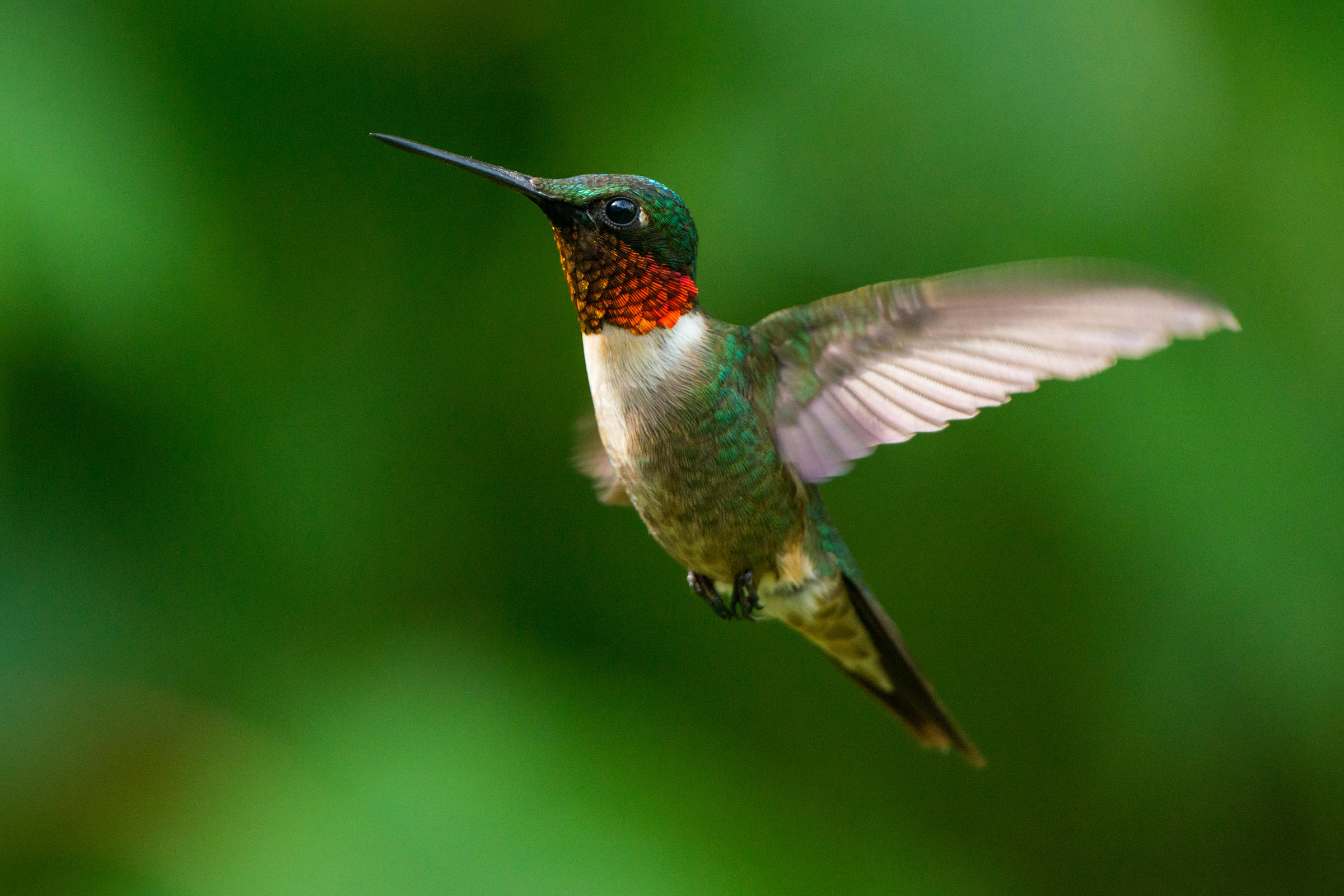
Male Ruby-throated Hummingbird
They are Ruby-throated hummingbirds that habitat in my back yard, close to the water in the wetland. I have seen numerous varieties here and this year is a tragedy. Only one is a constant visitor. I recognize him from previous years he is an older male, but no females or immatures or any of the young that were born here in the last few years. They nest about one hundred and fifty feet from my back door.
My wife’s aunt got us on to supplementing their food sources as the flowers come later in the summer and the birds can arrive in early May. They are hardy and to be admired. They are magic in action, taken for granted by most, they-are-amazing. She (my aunt) would have ten or more banging on her patio windows in the spring — she is passed now — that would get her busy cleaning the feeders and making the food. That was some 15 years ago and we have continued what she has taught us. Hummingbirds are unique in the bird library, mystical creatures they have amazed even the old ones.
I have been a curious seeker of bird wildlife and have frequented Cornell University website. I have their app of North American birds. It is a large data base some 1.5 gigabytes to download. And their app which catalogues all the species passing through my home has hundreds of species. We are on the great migratory path that sees the spring arrival of many, many species and the fall departure of the flocks as they head south for the winter.
Geese, Swans, Ducks and Cranes, hummingbirds and all the grassland birds one can witness. It is beauty in action. Animated and real, separate from the lies of the world.
The app supplies sounds of birds, their calls and threats, the mating sounds…their habitat and health. And one can help by counting for them. Which is how numbers are established
The skies where black with them at one time, the fall hunt for geese and ducks were annual events that drew many duck/geese hunters.
But…
There has been a 30% decline in bird populations since the 1970 count. Some species more than others are suffering.
The decline in the hummingbirds is just one, in fact that loss is significant of all marsh birds and grassland birds; waterfowl and the great predators. I use to see an lot of hawks and falcons, golden eagles.
Grassland birds are having a real tough time with the greatest decline of some 53% of 1970 numbers. More than half are gone from that abundance. That’s like waking up one day and finding there are now only 3.5 Billion people. A lot would jump for joy and see that as a benefit, since they believe the world is overpopulated.
Now let me get something straight. The 1970 numbers were in decline at ‘that’ time. That overall is not even close to the numbers that were here when the European men and women settled these lands and a plough and a horse cut the deep rich grass open for the first time in ten thousand years, exposing the rich black soil of ancient Buffalo dung in the Canadian prairies. Before that there was two miles of ice above our heads.
There has been a 50% reduction in waterfowl and I would claim a lot more that that; when I came here some 15 years ago the geese were as thick as fleas in the sloughs and wetlands. I owned a convent that I refitted as a bed and breakfast and geese hunters were a fall money maker for me.
In the last five years I have seen the marsh birds drop drastically; last year I had some twenty odd black birds of various persuasions and color nesting no more less than 200 feet from my backdoor. Red wing and yellow wings, orioles and cowbirds also sharing the marsh.
Raptors have dropped some 200%. With them being at the top of the food chain, the concentrations of toxins and chemicals that are killing birds are more profound. Many will say “Aw well ya know bird flu has a lot to do with it.”
These bird losses are a strong signal that our human-altered landscapes are losing their ability to support birdlife.
~Ken Rosenberg, Cornell Lab of Ornithology
I say bullshit. When you leave no room for wild life?
Between the planes spraying overhead for geoengineering purposes; the farmers who are chemically addicted and spray for all kinds of reasons. The airplanes used in spraying crops make a hell of mess around here. I saw one instance some ten years ago were a farmer was spraying with a small helicopter. It was a day not unlike today, and on that day I saw a hundred birds fall from the sky like rocks and bounce of the highway a few miles after I passed him desiccating his fall wheat for harvest. Traffic running over them like they were wet red rags. Blowing behind the passing trucks and cars as they passed like autumn leaves on a highway. It was a bad day that day, I have never forgot it, and if one extrapolates out from that one sighting…
Grassland species are hit the hardest as more and more grassland is claimed for monoculture industrial farming, nothing is being left for the wild. Farmers, I am witnessing are encroaching every year on the wetland. Cutting down the hedge row of trees and shrubs between sections of land. More and more they take, for few more dollars. Using bulldozers to claim submerged land. Trees are bulldozed for a few more acres, but sometimes that is the only wild habitat around for grassland birds and marsh birds. Where i live they drain the wetland to build a town, and haven’t stopped since.
Rose-Breasted Grosbeaks, 1 in 4 lost, 1 in 3 Orioles are gone.
In a Cornell study of the losses, the authors state…
“Species extinctions have defined the global biodiversity crisis, but extinction begins with loss in [abundance of individuals that can result in compositional and functional changes of ecosystems]. Using multiple and independent monitoring networks, we report population losses across much of the North American avifauna over 48 years, including once common species and from most biomes. Integration of range-wide population trajectories and size estimates indicates a net loss approaching 3 billion birds, or 29% of 1970 abundance. A continent-wide weather radar network also reveals a similarly steep decline in biomass passage of migrating birds over a recent 10-year period. This loss of bird abundance signals an urgent need to address threats to avert future avifaunal collapse and associated loss of ecosystem integrity, function and services.”
Three billion birds are a terrible indicator of the environmental ill-health and ecosystem integrity. And it is not a good sign. In fact its Biblical in its significance.
Many would point to the climate and ‘Global warming’ the bullshit hoax of the last ten centuries. Climate is not the case when one looks closely. In fact more carbon has increases the amount of trees and shrubs and wild plants worldwide.
There has been a serious drop in insect population, the largest enough to cripple any ecosystems, with Germany seeing a whopping 75% decline in insect populations in 27 year period.
In Saskatchewan we see; Neonicotinoids, Atrazine, Pyrethrin, inert/formulants, glyphosate, Flupyradifurone rage across lands and exterminate all insects. Mono-culture will not suffer a single insect eating what they grow and subsequently pour more than what is required on their lands, so much so, that a single butterfly flying over a yellow Canola field is dead before it reaches the other side. These places are monoculture deserts, with no insects. And the chemicals are even killing the microbes and microbiome below the ground.
Flupyradifurone a supposed alternative from neonicotinoids it is as bad and poses the similar risks as the latter. And add a few more.
On a day trip last weekend, to a national park an hour away I had mentioned how there were not many bugs on the windshield and the conversation struck up about the decline in insects. My wife and I agreed and went their and came home without washing that windshield. There where a tiny amount compared to what should have been. I would have had to stop and clean the windshield, normally as I have worn glasses my whole life and am a stickler for them to be clean and free of anything that impedes my vision — remember now I am an artist and vision is vital in importance. So a clean windshield is paramount.
A Saskatchewan Network for Alternative Pesticides (SNAP) reported that between 2004 and 2021, 58.5 % fewer insects were squashed onto car license plate. Now you might think that is a funny statistics but it speaks to a serious problem with flying insects. And if you think about it, it an excellent gauge for what I speak about here.
On the Dragonfly population…
In regards to dragonflies, I see them as a very special species of insect they eat other insects, and have a multitudes of coloration, iridescent and metallic colors in combinations of reds and golden yellow, brown and black pigments some in the greens and blues use a special type of cell on their body that reflects blue and yellow light.
They are large and small, and the particular clown face is a wonder to see up close. The intricate patterns of wings and gossamer branches. The wetlands would teem at one time with adults and the nymphs. They will feed on tadpoles and small fish and insect larvae. I remember back 15 years ago seeing them collect on a pair of slacks that had been wearing that day, a particular color they were attracted to and my wife took pictures of a hundred or so on my pants legs as I sat in the hot Saskatchewan sun. They would move their wings to cool themselves, some would leave and come back. They were a golden yellow and quite large. I have seen that many since, I see very few of the golden type.
But this one year especially in a series of years witnessing the drastic decline in their population. Has been shocking. I have seen maybe five or ten at most of all species. It has been cold for July and the last five years has seen cooler summers and longer winters. You might say the cooler climate has been a point in their decline. But life adapts always and its not that cool!
Pesticides, herbicides, fertilizer are all draining into precious wetland that a farmer despises more than protects. The bottom line is money over nature.
Pollinators are suffering the most, as bees have been at the forefront of pollinator insect decline for some decades without any recourse. Big tech has come up with a micro drone that will replace the bee it seems, and it will pollinate more efficiently that the bee. Bees are now imported from Europe were many chemicals are totally banned. Stronger queens are imported from Baltic states to Canada.
I use to watch fireflies at night and few weeks ago went out to witness a poor turnout of glowing males, I have seen them as a ocean of stars in front of my eyes in a dark marsh sometime around 11:00 pm. My sighting failed to produce a few.
With birds declining because of chemicals and a generally sick and toxic environment, they suffer again as their food source is also in decline for the same reasons.
Black birds , Larks, Warblers, Finches and Sparrows are all in decline in North America, in some places to a greater extent than others, but they all are threatened and so is their food, and one day the reality of “Silent Spring” might be what we awaken too.
I truly hope I am not around to witness that sin. I really do. I know the technocratic crowd will hail a new world to come, where extinct species will be brought back and nano technology will clean the environment. Personally I prefer nature in control of its own.
Albert Einstein once said that if the bees goes extinct, man would follow in just four short years later. If insects in general; and birds of all variety go extinct, how long then before it all collapses.
Technocrats are a sorry mess of humanity.
 don't worry you can change this later
You must be logged in to post a comment.